Local Requirements · Homeowner guide
Replacing a Furnace or Boiler? Why the Chimney Gets Checked Too
A heating replacement is also a chimney decision. Here is what the verification paperwork asks, why it exists, and how to keep the permit on schedule.
When an old oil boiler or furnace finally gives out, most homeowners focus on the new unit, the fuel and the installer. The chimney rarely comes up until someone asks whether it is ready to vent the new equipment.
In Vernon Township, that question is written down. The township's Building Department posts a form called Chimney Verification for Replacement of Fuel-Fired Equipment, a New Jersey Uniform Construction Code form. This article explains what it asks, why a new appliance changes the chimney's job, and how to plan the work so nothing holds up the final inspection.
Why a new heating appliance changes the chimney's job
A chimney flue is sized and lined for the appliance it serves. Swap that appliance and the match can break. A modern boiler or furnace usually wastes less heat up the flue, so its exhaust is cooler. Cooler exhaust condenses more easily, and the water it leaves behind is acidic.
The Chimney Safety Institute of America warns that exhaust from high-efficiency gas appliances carries a lot of water vapor, which makes a flue more corrosive. CSIA also notes that clay liners in chimneys that once served oil furnaces can flake under those conditions and shed debris that blocks the flue. A blocked flue can push exhaust back into the house.
Old residue is the other concern. Decades of oil soot and scale sitting in a flue do not belong under a new gas appliance, and the verification form asks about exactly that.
What Vernon's chimney verification form asks
The form, labeled U.C.C. F370, asks a verifying individual and company to confirm a short list of conditions before the new equipment is signed off. For conversions, replacements and new or added appliances, the person signing confirms the following.
- The chimney or vent is in good repair
- It is clear of obstruction
- Where it served a liquid or solid fuel appliance, it is substantially clean of residue from that use
- It is appropriately lined and sized for the appliance or appliances being installed
Liner details travel with the permit
If a liner is being installed, the form says all documentation on the liner must accompany the permit application. It asks for the manufacturer, model and UL listing, whether the liner is stainless steel or aluminum, the size of the appliance vent and the liner, the chimney height, and the connector length and rise.
What the form does not replace
The form states that it may not be submitted by a homeowner in lieu of the required inspection. A homeowner can instead choose not to submit verification, but then the owner must be present for the township's inspection so the chimney vent connector can be removed and reinstalled.
Which replacements it covers
The form lists the common heating changes by name: oil to gas conversion, gas to oil conversion, gas appliance replacement and oil to oil replacement. It also records the existing vent or chimney, from a B-vent or L-vent to a flexible liner, a power vent, or a masonry chimney that is either tile lined or unlined.
One case is spelled out as needing no verification. When a direct-vent appliance replaces another direct-vent appliance, the form says no verification is required. If a new direct-vent unit replaces one that used the chimney, the form still asks for confirmation that the existing chimney is lined and sized for any remaining appliances, such as a water heater left on the old flue.
What a chimney inspection looks at before the swap
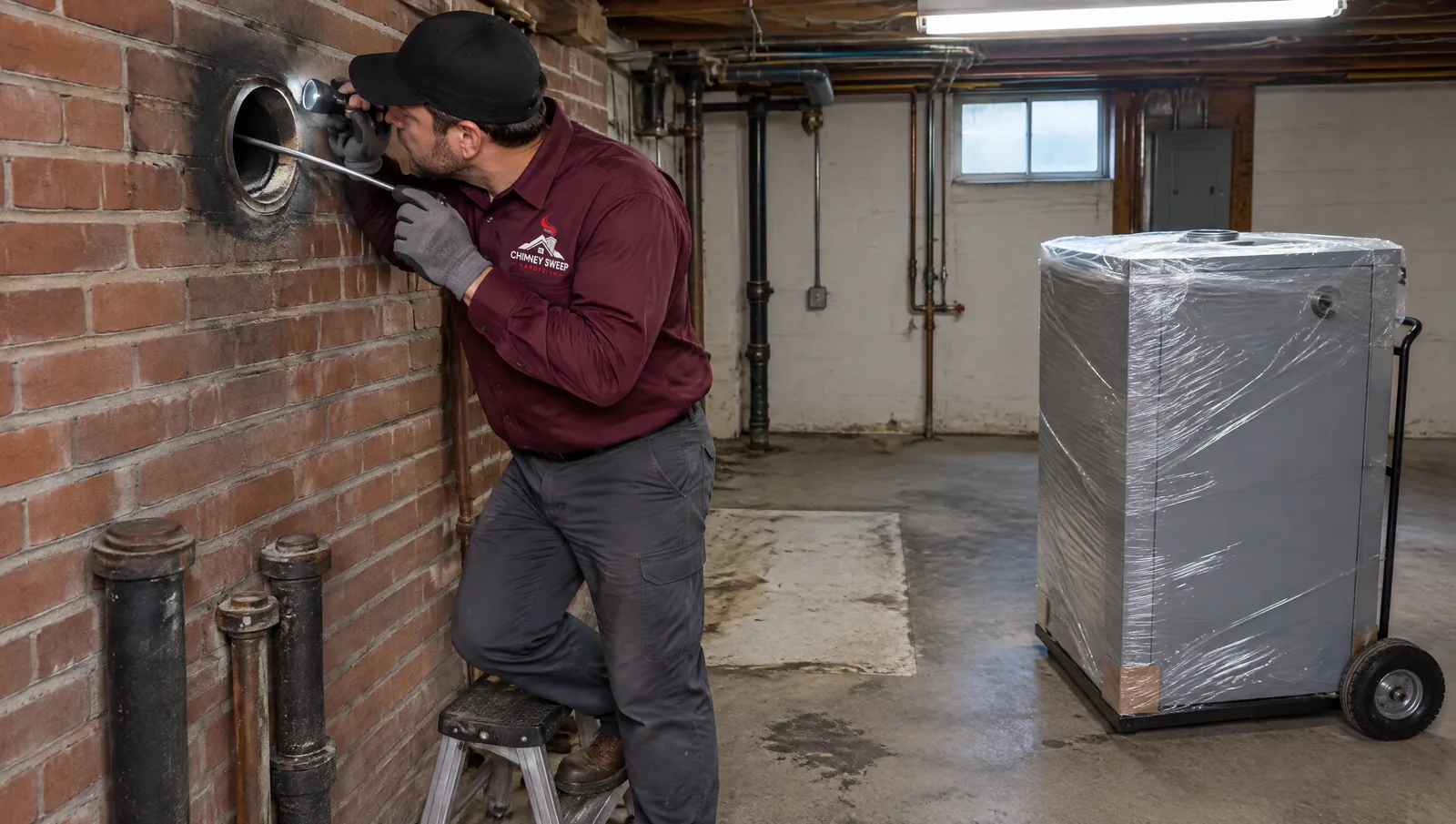
CSIA recommends a Level 2 inspection when an appliance is added or replaced with one of a different fuel, efficiency or type. A Level 2 inspection covers accessible areas such as attics, basements and crawl spaces, and it includes a video scan of the flue. That scan is what shows cracked or missing tiles, gaps at the joints and heavy deposits that cannot be seen from the roof.
The inspection answers the form's questions directly. It shows whether the flue is in good repair and clear, how much old residue is present and needs sweeping out, and whether the existing liner suits the new appliance or a properly sized liner is needed.
For homes in the township where a boiler or furnace change is coming, our page on chimney service in Vernon Township covers inspections, relining and sweeping ahead of the new equipment.
Timing the work so the permit closes
The form sets out when it is due. For minor and emergency work, it must be provided with the permit application. For all other work, under a full permit, it must be presented to the code official before the final inspection. In practice, that means the chimney should be looked at early, not on the day the old boiler is hauled out.
- Have the chimney inspected while you are still choosing equipment, so liner needs are known before the order
- Share the inspection findings with your heating installer so the vent plan and the chimney agree
- If a liner is needed, collect its documentation for the permit application
- Schedule any sweep, repair or relining before the new appliance is connected
- Confirm current requirements with the Building Department, since forms and procedures are revised over time
Outside Vernon
Because F370 is a state Uniform Construction Code form, you may come across the same questions in other New Jersey towns. Procedures can differ by municipality, so the construction office in your own town is the place to ask whether the form applies to your project and when it has to be filed.