Chimney Cap Installation & Repair in Hardyston, NJ
Chimney cap installation and repair in Hardyston, NJ comes down to one question: what is getting into your flue from the top? A cap is a metal lid with a mesh screen that sits over the flue opening. It keeps out rain, leaves, birds and squirrels, and it catches embers before they land on the roof. When it rusts through, blows loose or was the wrong size to begin with, all of those problems come back.
Most of Hardyston lies in the New York-New Jersey Highlands, and lake communities such as Lake Stockholm and Beaver Lake sit among the hills. Chimney tops here face long winters, autumn leaf fall and plenty of curious wildlife. This page explains how to tell a cap problem from a crown or flashing problem, which cap suits which chimney, and what a repair or replacement visit involves.
Chimney Sweep Hardyston installs and repairs chimney caps across Hardyston Township. Call (862) 362-1333 or use Request Service, and mention anything you have seen in the fireplace, such as water, twigs or signs of an animal.
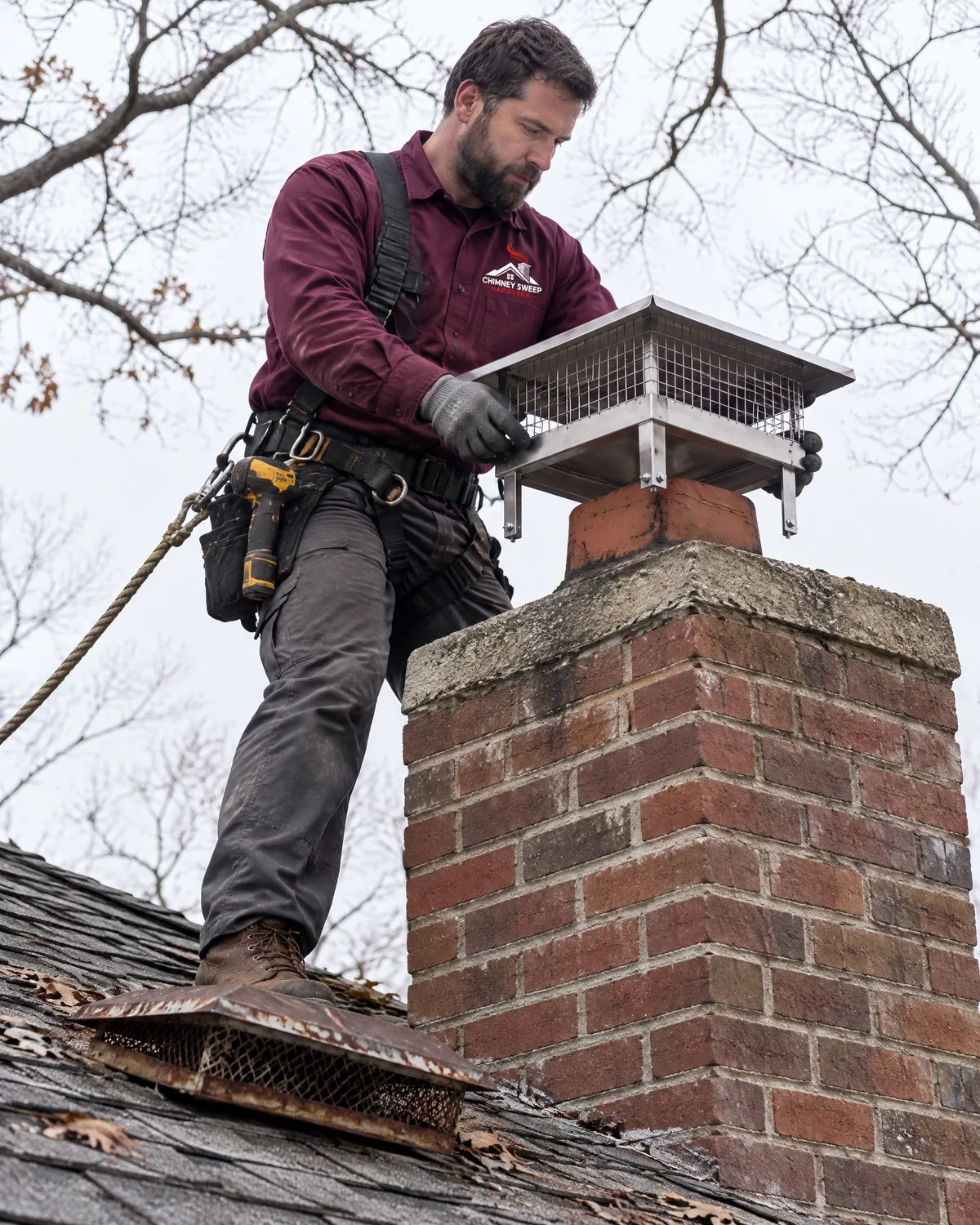
Which fix does your chimney top need?
No cap at all
An open flue collects rain and invites nesting. A properly sized cap with mesh on every side is the usual answer, once anything living inside has left.
Cap rusted, bent or missing its mesh
Replacement is usually the better choice. Corroded mesh tears again, and a rusting lid keeps staining the brick under it.
Cap looks fine but water still gets in
Look at the crown and the flashing next. A cap covers the flue opening only, not the masonry around it.
Two or more flues, or a tired crown
One multi-flue cap can cover the whole crown and every flue at once, but the crown under it has to be sound first.
Framed chimney finished in siding
That top is a chase cover, not a crown. A rusted or sagging chase cover is replaced, often with the cap built into it.
Signs your chimney cap is missing, failing or the wrong one
A cap problem rarely shows from the driveway. Most of the clues turn up indoors, at the fireplace or at the appliance the chimney serves, and they tend to appear after rain, wind or a few warm spring days.
- Water dripping into the firebox or pooling on the smoke shelf during calm, steady rain
- Rust on the damper plate, the fireplace doors or the firebox floor
- Orange or brown streaks running down the brick just below the top of the chimney
- Twigs, leaves or bits of nest falling onto the grate
- Scratching, fluttering or chattering sounds inside the flue
- A cap that sits crooked, rattles in the wind or has gone missing after a storm
- Mesh with holes, open corners or a heavy coat of soot and creosote
- A damp, musty smell from the fireplace after wet weather
What rust streaks are telling you
Streaks that begin right under the cap usually mean a galvanized steel cap has lost its zinc coating. Every rain washes more rust onto the masonry, so the stain darkens each year. Stainless steel does not rust that way, and copper weathers to a brown or green patina instead.
Why caps fail on a Highlands chimney
A cap is a simple part that lives in the harshest spot on the house. It takes wind, ice, falling branches and hot exhaust, often for decades. These are the usual reasons one stops doing its job.
Thin metal
Galvanized steel relies on a thin zinc coating. Once weather wears through it, the steel underneath starts to rust. The mesh is thinnest, so it goes first, and the lid follows. Exhaust adds to the wear on chimneys that vent oil or gas appliances, since CSIA describes the water-laden exhaust of gas appliances as corrosive to the flue.
Wind and ice
A cap held by two or three loose screws can lift off in a hard gust. Ice that builds on the lid and mesh through a long winter adds weight and strain to the fasteners.
The wrong size
A cap that does not match the flue tile sits loose and cannot be clamped properly. One that is too short puts the lid close to the flue opening, which can choke the draft.
Clogged mesh
On a wood-burning chimney, soot and creosote collect on the screen. Mesh that is packed with residue restricts the flue much like a blockage lower down, and the fireplace may start to smoke.
Branches
On a wooded lot, a falling limb can bend the lid or knock the whole cap off. A quick look at the chimney top after a big storm is worth the trouble.
What sits on top of your chimney, and which part is failing
Several different parts can sit at the top of a chimney, and each protects something different. They are easy to confuse, so a good diagnosis starts by naming what is actually up there and then matching the symptom to it.
- Drips into the firebox in calm, straight-down rain: an open flue or a cap with a damaged lid
- Damp brick in the attic or stains where the chimney narrows: the crown or the masonry
- A ceiling stain beside the chimney after wind-driven rain: the flashing
- Water around a metal fireplace or inside a sided chase: the chase cover
Chimney cap
A metal lid on legs, usually with mesh around the sides, fastened over a single flue tile or over the whole chimney top. Its job is the flue itself: rain, animals, debris and embers. It does nothing to protect the brick around the flue.
Crown
The concrete or mortar slab that seals the top of a brick chimney around the flue tiles. It sheds water off the masonry. A cracked crown lets water into the chimney even under a perfect cap.
Chase cover
The sheet-metal top on a framed chimney, the kind built around a factory-made metal flue and finished with siding. On that style of chimney it does the crown's job. When it rusts or sags into a dish, water sits on it and finds its way down the chase.
Top-sealing damper
A spring-loaded lid mounted at the very top of the flue and opened by a cable that runs down to the fireplace. It closes the flue whenever the fireplace is idle, and most models include their own hood and mesh. CSIA notes that a tight-sealing top-mounted damper can reduce the air flowing down a chimney, which helps with cold drafts and odors.
Chimney cap repair: what can be fixed in place
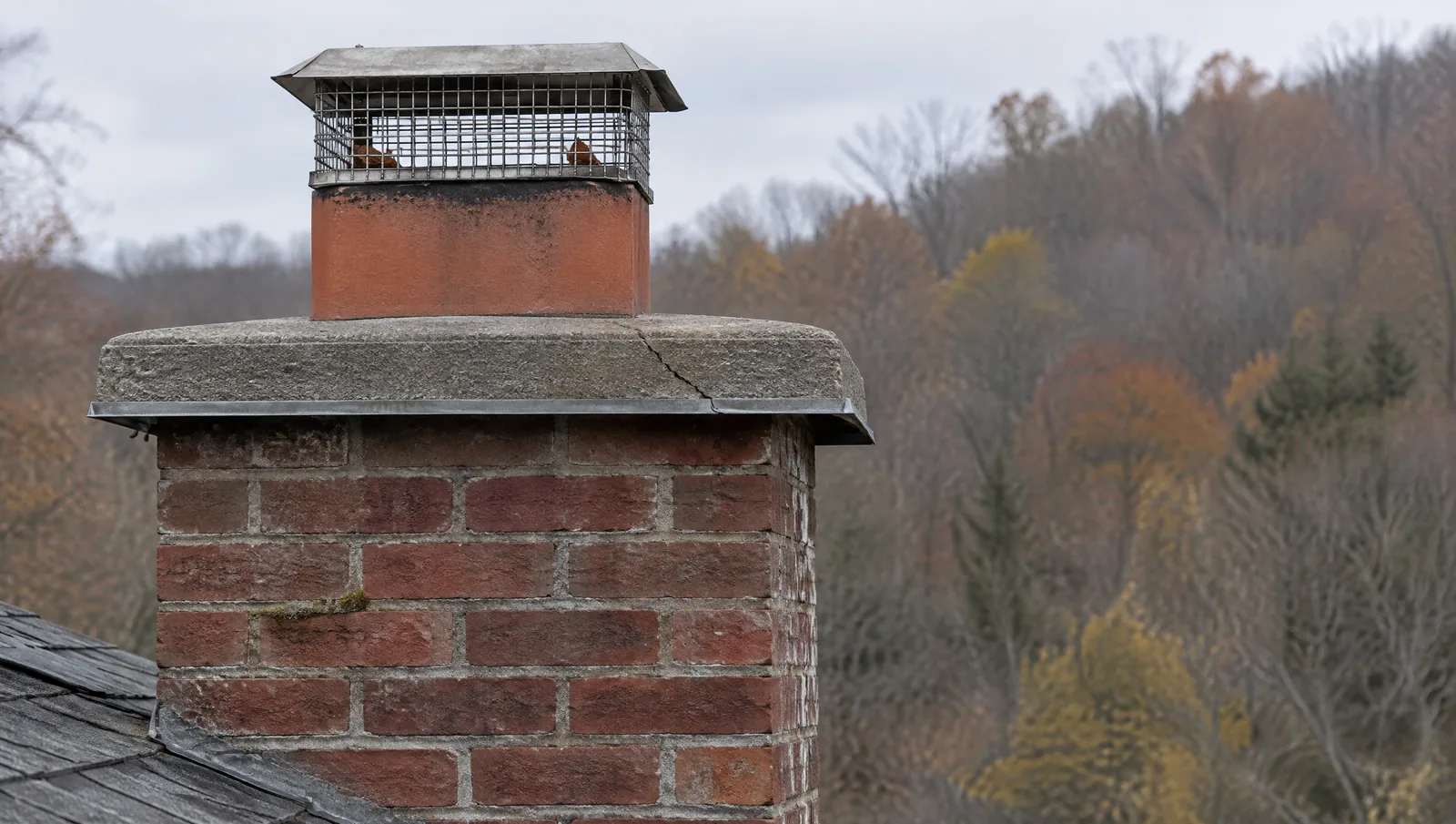
A cap problem does not always mean a new cap. A sound stainless or copper cap that has worked loose or taken a knock can often be put right in one trip, as long as the metal itself is still solid.
- Refastening a loose cap with hardware suited to how it mounts, on the flue tile or on the crown
- Straightening a lid bent by a branch, if the metal has not cracked
- Clearing soot, creosote and leaves off the mesh so the flue can breathe again
- Resetting a cap that has slid off center so the lid sits squarely over the opening
- Replacing a damaged screen panel on caps built with removable mesh
Where repair stops making sense
Rust is the dividing line. Once galvanized mesh has rusted through or the lid is flaking, patching it buys a season at most. Torn mesh also stops keeping animals out, which was the main reason for having a cap. At that point a new cap in a longer-lasting metal costs less over time than repeated fixes.
Choosing a replacement cap: fit, mesh and metal
A good cap is chosen for the chimney it will sit on, not picked off a shelf. Four decisions shape the choice, and the last one decides how long it lasts.
Single-flue or multi-flue
A single-flue cap clamps onto one flue tile that stands up above the crown. A chimney with two or three flues, say one for the fireplace and one for a boiler, can take a separate cap on each tile or one larger multi-flue cap that covers the entire top. A multi-flue cap fastens to the crown and hides it from view, so any crown cracks need repair before it goes on.
Mesh and spark arrestors
Mesh keeps animals out and catches embers before they reach the roof. On wooded and lakeside lots, full mesh sides matter more than the lid. A rain hood with open sides keeps water out but not squirrels.
The New Jersey edition of the International Residential Code (section R1003.9.1) sets the rules for a spark arrestor on a masonry chimney. Its net free area must be at least four times the net free area of the flue outlet. The openings must stop anything wider than half an inch but let a 3/8-inch sphere through. The screen or the cap must also be removable so the flue can still be cleaned.
Height and draft
The lid has to sit high enough above the flue for smoke to leave freely. Under CSIA's procedure for a Level 2 inspection, the inspector confirms that a rain cap is not obstructed and does not create a restriction at the top of the chimney. A cap that is too short, or a screen with openings smaller than the code allows, can turn a fireplace that drew well into one that smokes.
Stainless, copper or galvanized
Galvanized steel is the cheapest and the first to rust. Stainless steel holds up far longer and does not streak the brick. Copper is chosen for its looks and long life, and it darkens to a patina over time. On a chimney venting an oil or gas appliance, the metal also has to stand up to corrosive exhaust, which is one more reason stainless is the common pick.
Animals, nests and draft: the safety side of a cap
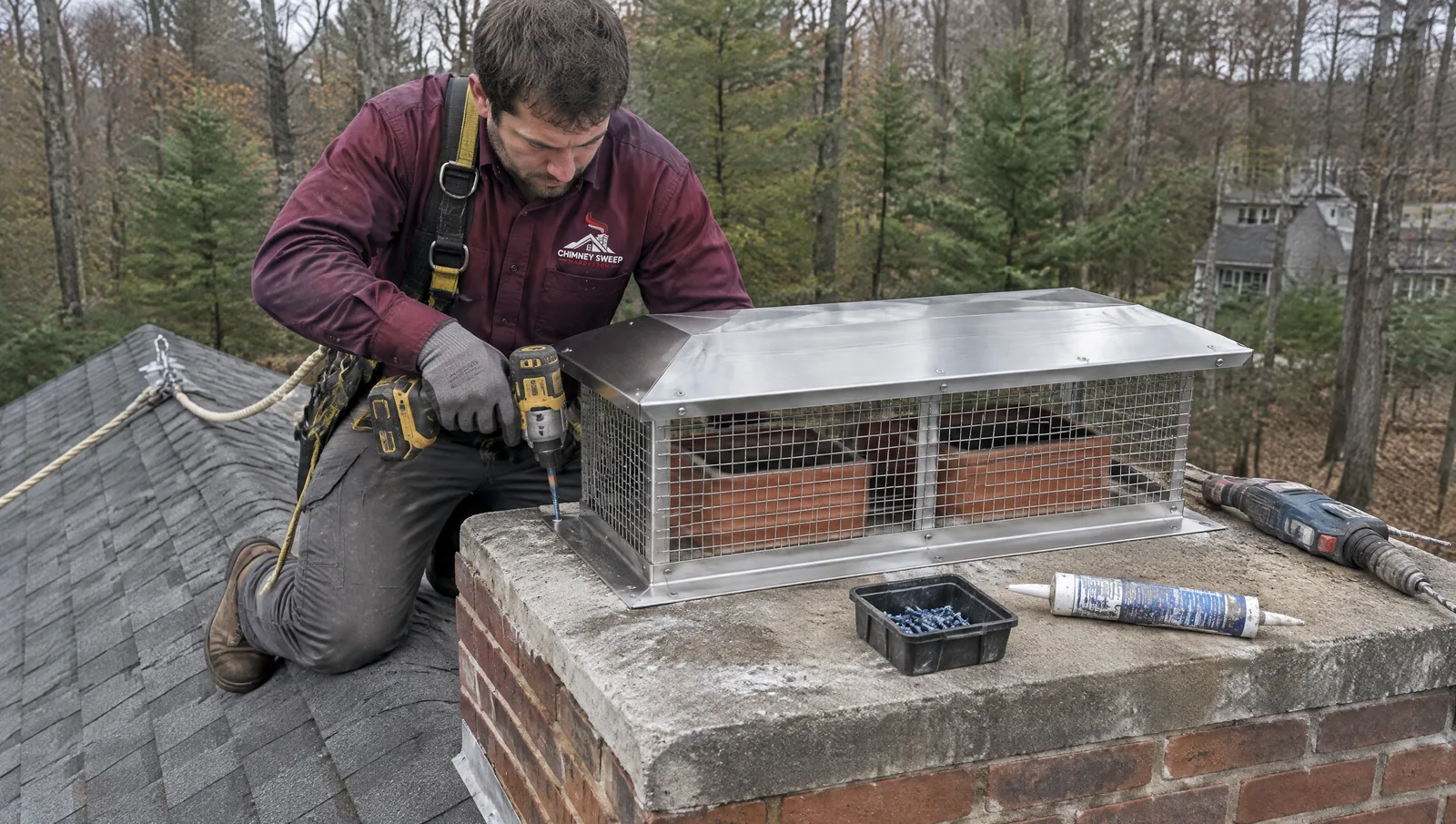
Nests in a flue are a health issue, not only a noise issue. According to CSIA, a flue choked by a bird or animal nest is one way carbon monoxide and soot end up indoors. A nest in the flue serving a furnace or boiler matters as much as one above the fireplace, because those appliances run on their own all winter.
Found an animal living in the flue? Leave the damper shut so it stays out of the house, and never use a fire to chase it out. Humane World for Animals warns against using smoke or fire, because young raccoons cannot climb out and their mother stays with them. Chimney swifts fall under the federal Migratory Bird Treaty Act, so an active nest is left alone until the birds move on. A cap goes on only after every animal is out.
Cap work happens on the roof, often on a steep pitch with a long drop. It calls for proper fall protection and dry footing. Until the work is done, make sure the home's carbon monoxide alarms have good batteries.
Cap job pricing: what drives the estimate
Cap prices depend on the chimney as much as the cap. An estimate for this work usually turns on the details below.
- How many flues there are, their size, and whether each tile is round or rectangular
- Separate single-flue caps versus one multi-flue cap built to the crown's measurements
- A stock size versus a custom-made cap for an unusual chimney top
- Metal: galvanized, stainless steel or copper
- Whether spark arrestor mesh, a wind-directional top or a top-sealing damper is part of the job
- Roof height, pitch and how easily the chimney can be reached
- Crown or flue tile repairs needed before anything can be fastened
- Clearing nest material or debris out of the flue first
Ask what the cap will be fastened to
An estimate should say whether the cap mounts to the flue tile or to the crown, and what shape that surface is in. A new cap screwed into a crumbling crown will not stay put through many winters.
What happens on a cap installation or repair visit
The visit begins by looking down the flue, not just at the old cap. Nest material, debris or a cracked top tile has to be dealt with before anything new goes on top.
Next comes measuring. Each flue tile is measured on the outside, along with how far it rises above the crown, so the cap fits snugly and the lid sits at the right height. For a multi-flue cap, the whole crown is measured instead.
The cap is then fastened with hardware made for that mounting style and checked so the lid sits level and the mesh closes every gap. Ask for photos of the finished top, since it is hard to see from the ground.
If the chimney has not been cleaned in a while, it makes sense to sweep it before the new cap goes on. To book a visit, call (862) 362-1333 or choose Get Estimate.
Homeowner guide: Animals in the Chimney: Prevention and What to Do
Chimney Cap Installation & Repair questions
How is a chimney cap sized so it doesn't hurt the draft?
A cap is sized from the outside of the flue tile and from how far the tile rises above the crown, so it clamps on snugly and the lid sits high enough for smoke to leave freely. CSIA's inspection procedure flags any rain cap that restricts the top of the chimney. The mesh matters too, because openings that are too small clog with soot quickly.
Can a chimney cap fix a fireplace that smokes on windy days?
Sometimes, when the smoke comes from wind gusting across an open flue. A cap with a wide lid, or a wind-directional top, shields the opening from those gusts. A cap will not cure smoke caused by a damper that is partly closed, a dirty flue or negative pressure inside the house, so those causes are ruled out first.
Can my chimney still be cleaned once a cap is installed?
Yes, a cap is built to come off or open for cleaning. The spark arrestor section of New Jersey's edition of the International Residential Code keeps the screen accessible, with a removable screen or cap, so the flue can still be swept. During a cleaning the cap is usually lifted off, set aside on the roof and fastened back down afterward.
Book chimney cap installation & repair in Hardyston
Tell us what you are seeing and the town you are in.